
The Complete Guide to Becoming a Pilates Instructor in Singapore
Whether you're looking to change careers, start a side hustle, or deepen your personal Pilates practice, becoming a certified Pilates instructor in Singapore offers exciting opportunities in a booming fitness industry. This comprehensive guide will walk you through everything you need to know about becoming a Pilates instructor in Singapore.

Table of Contents
Overview of the Pilates Industry in Singapore

The Pilates industry in Singapore is experiencing significant growth, with increasing awareness of health and wellness driving demand for qualified instructors. The fitness sector has evolved beyond traditional gym workouts, with Pilates becoming a preferred choice for people seeking low-impact, mind-body exercises that improve strength, flexibility, and posture.
Singapore's strategic location as a fitness hub in Southeast Asia, combined with its affluent population and health-conscious culture, creates excellent opportunities for Pilates professionals. Many studios are actively seeking qualified instructors, with some offering competitive packages including sign-on bonuses and sponsored certifications.
Types of Pilates Instructors
1. Mat Pilates Instructors
Mat Pilates instructors teach classes using body weight and small props like resistance bands, balls, and blocks. This is typically the entry point for most instructors and requires less initial capital and time investment in equipment training.
2. Equipment-Based Instructors
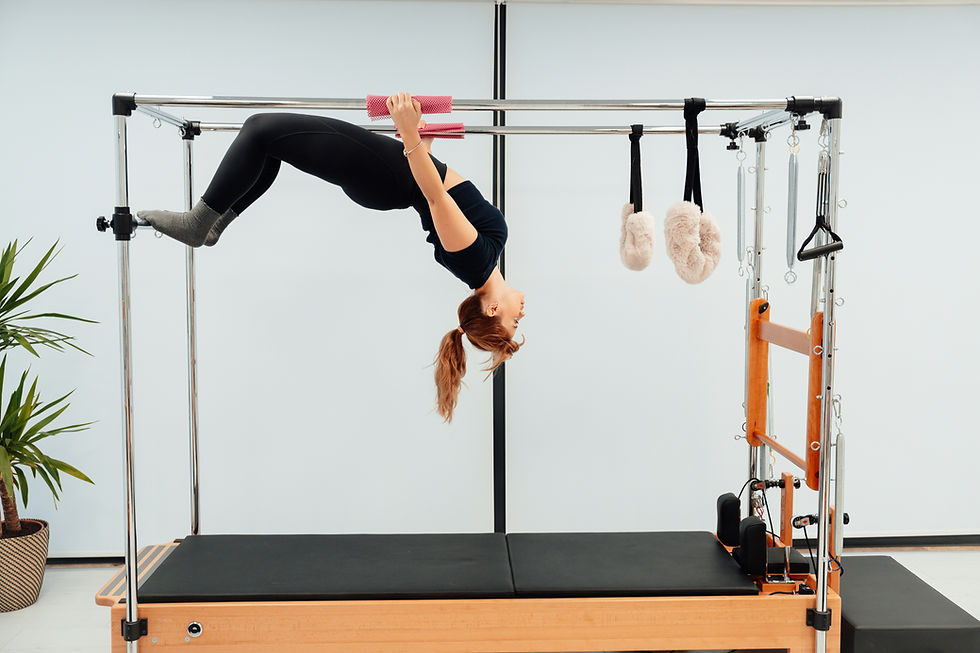
Group Equipment Pilates typically refers to Reformer classes, distinct from Mat classes. These instructors are certified to teach on Pilates apparatus such as:
Reformer: The most popular Pilates machine - commonly used for Group Equipment Pilates classes
Cadillac/Tower: Advanced equipment for therapeutic work
Chair: Compact equipment for strength and balance
Barrel: Specialized equipment for spinal mobility
3. Specialized Instructors
Rehabilitation/Clinical Pilates: Work with physiotherapists and healthcare providers
Prenatal/Postnatal Pilates: Specialized training for pregnant and postpartum women
Senior Pilates: Focus on older adults and age-related movement issues
Classical? Contemporary? Modern Pilates? Pilates-Inspired?
The Pilates world has evolved significantly since Joseph Pilates first developed his method in the early 20th century. Today's instructors can specialize in different approaches, each requiring distinct training and appealing to different client needs. Understanding these differences is crucial for choosing your certification path and career direction.
Classical Pilates Instructors
Classical Pilates, also known as "Contrology" (Joseph Pilates' original name for his method), stays true to the founder's original system and philosophy. Classical instructors follow the traditional approach exactly as Joseph Pilates taught it.
Key Characteristics:
Fixed Exercise Order: Classes follow a specific sequence that Joseph Pilates designed, moving from fundamental to advanced exercises in a predetermined flow
Original Equipment: Uses traditional apparatus like the Reformer, Cadillac, Wunda Chair, and Ladder Barrel exactly as Joseph Pilates designed them
Six Principles: Emphasizes the original six principles: Concentration, Control, Centering, Flow, Precision, and Breathing
Minimal Modifications: Exercises are taught in their original form with limited modifications for different body types or limitations
Teaching Examples:
A classical Mat class begins with "The Hundred" and follows the traditional order through to "Push-Ups". On the Reformer, sessions typically start with "Footwork" and progress through the classical repertoire in Joseph Pilates' intended sequence. Cuing focuses on the original terminology and concepts, such as "powerhouse" for the core.
Ideal for Instructors Who:
Appreciate tradition and historical authenticity
Prefer structured, systematic approaches
Want to preserve Joseph Pilates' original vision
Enjoy the challenge of mastering a precise method
Contemporary Pilates Instructors
Contemporary Pilates incorporates modern exercise science, anatomy knowledge, and movement research while maintaining Pilates' core principles. This approach has evolved to be more inclusive and adaptable to diverse populations.
Key Characteristics:
Flexible Exercise Selection: Instructors can modify exercise order based on client needs and class objectives
Modern Anatomy Understanding: Incorporates current knowledge about bio-mechanics, spinal health, and movement patterns
Extensive Modifications: Offers numerous variations and modifications for different fitness levels, injuries, and body types
Equipment Variations: May use additional props and modified equipment beyond traditional apparatus
Teaching Examples:
A contemporary Mat class might start with gentle warm-up movements and spinal mobility before progressing to strength exercises. Reformer sessions can be customized based on individual assessment, potentially focusing on specific muscle groups or movement patterns. Instructors might incorporate props like foam rollers, resistance bands, or stability balls to enhance traditional exercises. Cuing emphasizes anatomical accuracy, such as "engage your deep abdominals" instead of "pull your navel to spine".
Ideal for Instructors Who:
Want flexibility in class design and exercise selection
Are interested in working with diverse populations (seniors, athletes, rehabilitation clients)
Enjoy incorporating new research and techniques
Prefer evidence-based approaches to movement
Pilates-Inspired Instructors
The fitness industry has seen an explosion of Pilates-inspired workouts that borrow elements from traditional Pilates but create entirely new fitness experiences. These methods are particularly popular in Singapore's boutique fitness scene.
Lagree Method/Megaformer
The Lagree Method, performed on the Megaformer machine, is perhaps the most well-known Pilates-inspired workout. Created by Sebastien Lagree, this method combines Pilates principles with high-intensity interval training.
Key Differences from Traditional Pilates:
High-Intensity Focus: Emphasizes muscle fatigue and "time under tension" rather than Pilates' controlled, flowing movements
Cardio Component: Incorporates significant cardiovascular training, unlike traditional Pilates which focuses primarily on strength and flexibility
Equipment Design: The Megaformer has a stationary platform with moving carriages, different from traditional Pilates reformers
Class Structure: 45-50 minute classes with minimal rest between exercises, creating a more intense workout experience
Teaching Examples:
Classes might include 60-90 seconds of continuous lunges on the Megaformer to achieve muscle fatigue. Transitions between exercises are quick and designed to maintain elevated heart rate. Focus on "shaking muscles" and pushing to failure, contrasting with Pilates' emphasis on control and precision.
Key Characteristics:
Structured Level System: Classes are organized by difficulty levels (1.0, 1.5, 2.0, etc.) with specific exercises allowed at each level
Variety of Equipment: Combines traditional Pilates apparatus or modified Pilates apparatus with additional props and equipment
Group Fitness Atmosphere: Larger classes with music and more energetic environment than traditional Pilates studios
Accessible Approach: Designed to be welcoming to fitness newcomers while still challenging
Teaching Examples:
Level 1.0 classes focus on fundamental movements and basic equipment introduction. Higher levels incorporate more complex choreography and advanced apparatus work. Classes might blend Reformer work with TRX, weights, or other fitness equipment.
Barre-Pilates Fusion
Many studios in Singapore offer hybrid classes that combine ballet barre work with Pilates principles, creating another category of Pilates-inspired instruction.
Key Elements:
Isometric Holds: Extended muscle contractions at the ballet barre
Small Range Movements: "Pulses" and micro-movements to fatigue muscles
Pilates Core Work: Traditional Pilates mat exercises integrated with barre sequences
Music-Driven Classes: Choreographed to upbeat music unlike traditional Pilates
Choosing your Pilates Certification Programs
Choosing the right Pilates certification program is one of the most important decisions in your instructor journey. With multiple reputable programs available in Singapore, it's essential to understand the key factors that will impact your training experience, career prospects, and return on investment.
Key Factors to Consider When Choosing Your Certification
1. Financial Investment and Budget Planning
Pilates certification represents a significant financial commitment, and costs can vary dramatically based on the program scope and provider.
Typical Cost Ranges in Singapore:
Mat-Only Certifications: SGD 2,000 - 4,500
Equipment Add-Ons: SGD 1,800 - 3,500 each (Reformer, Cadillac, Chair, Barrel)
Comprehensive Programs: SGD 8,000 - 18,000 (includes multiple equipment certifications)
Examination Fees: SGD 200 - 500 per exam
Continuing Education: SGD 150 - 300 per workshop annually
Additional Costs to Factor In:
Study materials and manuals (SGD 200-500)
Practice sessions and studio rental for self-study
Travel costs if training at different locations
Lost income during intensive training periods
SkillsFuture Credits: Many Pilates certifications in Singapore are eligible for SkillsFuture credits, which can offset up to SGD 600 of training costs for Singaporeans over 25 .
2. Time Commitment and Schedule Flexibility
Training Format Options:
Intensive/Immersion Programs: 2-4 weeks of full-time training (6-8 hours daily)
Weekend Modules: Spread over 3-6 months with weekend sessions
Hybrid Programs: Combination of online learning and in-person practice
Self-Paced Options: Some programs offer flexible scheduling over 6-12 months
Total Hour Requirements:
Mat Certification: 100-200 hours (including self-practice and observation)
Equipment Certifications: 50-100 hours per apparatus
Comprehensive Programs: 450-600+ hours total
There are certification courses that require a lot less hours than the standard courses - but be aware that which course you get certified under may affect your employment opportunities.
3. Career Goals and Market Demand
Consider which certifications are most recognized and sought-after by Singapore studios:
Boutique Studios: Often prefer comprehensive certifications (BASI, Stott)
Fitness Chains: May accept various certifications but value practical teaching skills
Clinical Settings: Prefer contemporary programs with rehabilitation focus
Private Practice: Classical or comprehensive certifications often command higher rates
4. Learning Style and Support Preferences
Mentorship and Ongoing Support:
Some programs offer extensive post-graduation mentorship
Alumni networks and continuing education opportunities
Business development and marketing support
Job placement assistance
You could also approach the types of Pilates studios you'd like to work at to check if they provide any mentorship programs aside from certification courses (take it like an internship you take while attending Universities).
Detailed Program Breakdown
1. BASI Pilates (Body Arts and Science International)
BASI offers comprehensive teacher training programs that are college-level and rigorous. Their Singapore program includes theory, exercises, and teaching skills on all Pilates equipment. BASI is known for its thorough approach and strong anatomical foundation.
Key Features:
Comprehensive Global certification available
Strong emphasis on anatomy and bio-mechanics
Equipment and mat training included
Internationally recognized
2. STOTT Pilates
One of the most recognized contemporary Pilates certifications globally, STOTT Pilates incorporates modern exercise science principles. They offer intensive mat programs and equipment certifications.
Key Features:
Contemporary approach with anatomical precision
Modular certification system
Strong rehabilitation focus
Widely accepted internationally
3. Polestar Pilates
Polestar offers evidence-based Pilates education with a strong foundation in movement and rehabilitation sciences. Their Gateway Mat program is popular among beginners.
Key Features:
Evidence-based approach
Strong clinical foundation
Continuing education opportunities
Online learning options available
4. Power Pilates (Classical)
For those interested in classical Pilates, Power Pilates offers authentic training based on Joseph Pilates' original method. They have a presence in Singapore and offer comprehensive classical training.
Key Features:
Authentic classical method
Three levels: Beginner, Intermediate, Advanced
Strong lineage to Joseph Pilates
Emphasis on traditional exercise order
5. Balanced Body & Peak Pilates
These are other reputable certification bodies that occasionally offer training in Singapore or have recognized programs that Singapore studios accept.
How to Choose the Right Certification
Consider Your Goals and Interests
1. Teaching Style Preference
Classical approach: Choose Power Pilates or Romana's Pilates if you prefer traditional methods
Contemporary approach: Consider STOTT Pilates, BASI, Balanced Body or Polestar for modern, science-based training
Rehabilitation focus: Polestar or STOTT Pilates offer strong clinical foundations
2. Equipment vs. Mat Focus
Start with mat certification if you're budget-conscious or prefer group classes
Choose comprehensive programs (BASI, STOTT) if you want equipment training included
Consider your target teaching environment (studios vs. gyms vs. private practice)
Practical Considerations
3. Time and Schedule Flexibility
Intensive programs: Complete certification in 2-4 weeks (higher time commitment)
Modular programs: Spread learning over several months with weekend workshops
Online components: Some programs offer hybrid learning options
4. Budget Considerations
Generally,
Mat-only certifications: SGD 2,000-4,000
Comprehensive programs: SGD 8,000-15,000
Equipment-specific add-ons: SGD 1,500-3,000 each
*Consider SkillsFuture credits for eligible courses
5. Location and Accessibility
Choose programs offered locally in Singapore to reduce travel costs
Consider the reputation of the local host studio or educator
Factor in ongoing mentorship and support availability
Quality Indicators
6. Accreditation and Recognition
Look for internationally recognized certifications
Check if the program meets continuing education requirements
Verify if local studios recognize and prefer specific certifications
7. Curriculum Depth
Minimum 200+ hours for comprehensive certification
Anatomy and bio-mechanics components
Business and teaching methodology training
Hands-on practice and observation hours
8. Post-Certification Support
Ongoing mentorship programs
Continuing education opportunities
Job placement assistance
Alumni networks and community support
Course Structure and Requirements
Typical Certification Components
1. Prerequisites
Most programs require 10-50 hours of Pilates experience as a student
Some require basic anatomy knowledge or fitness background
Health clearance may be required
2. Core Curriculum (200-500 hours)
Anatomy and Bio-mechanics: Understanding the body and movement principles
Pilates Philosophy and History: Foundation of the method
Exercise Repertoire: Learning and practicing all exercises
Teaching Methodology: How to cue, correct, and modify exercises
Safety and Contraindications: Risk management and injury prevention
3. Practical Requirements
Self-practice hours: 50-100 hours of personal practice
Observation hours: Watching experienced instructors teach
Teaching practice: Supervised teaching with feedback
Written and practical exams: Assessment of knowledge and skills
Timeline Expectations
Mat Certification: 2-6 months
Equipment Add-ons: 1-3 months each
Comprehensive Programs: 6-12 months
Continuing Education: Ongoing throughout career
Career Prospects and Salary in Singapore
Employment Opportunities
1. Studio Instructor
Boutique Pilates studios
Fitness chains with Pilates programs
Wellness centers and spas
Corporate wellness programs
2. Private Training
One-on-one sessions (higher earning potential)
Small group training
Home visits
Online coaching
3. Specialized Roles
Clinical/rehabilitation settings
Prenatal and postnatal programs
Senior fitness programs
Athlete training and performance
Salary Expectations
Based on current market data, generally, Pilates instructors in Singapore can expect:
Group Classes
(depending on the group size and equipment used):
New instructors: SGD 30-60 per class
Experienced instructors: SGD 60-120 per class
Senior instructors: SGD 80-150 per class
Private Sessions
SGD 40-60 per session for new instructors
SGD 60-90 per session for experienced instructors
SGD 100-300+ per session for specialized or senior instructors
Full-time Positions:
Studio instructors: SGD 2,000-5,000 per month
Senior instructors/Studio managers: SGD 5,000-8,500 per month
Top earners: Up to SGD 15,000+ per month with bonuses
Factors Affecting Income:
Certification level and reputation
Years of experience
Specializations (rehabilitation, prenatal, etc.)
Location and studio prestige
Business and marketing skills for private practice
Getting Started: Step-by-Step Guide
Phase 1: Preparation (1-3 months)
Build Your Practice
Take regular Pilates classes (aim for 2-3 times per week)
Try different styles and instructors
Develop body awareness and understanding
Research and Choose Certification
Attend information sessions
Talk to current instructors
Consider your goals and budget
Check SkillsFuture eligibility
Prepare Physically and Mentally
Improve your own fitness level
Start reading about anatomy and movement
Develop discipline for intensive study
Phase 2: Certification (3-12 months)
Enroll in Your Chosen Program
Complete all required coursework
Maintain consistent self-practice
Build relationships with classmates and instructors
Maximize Your Learning
Take detailed notes
Practice teaching with friends and family
Seek feedback actively
Network with industry professionals
Phase 3: Launch Your Career (Ongoing)
Gain Experience
Start with substitute teaching
Offer free or discounted sessions to build confidence
Seek mentorship from experienced instructors
Build Your Reputation
Maintain high teaching standards
Continue education and training
Develop your unique teaching style
Build strong client relationships!
Expand Your Skills
Add equipment certifications (of increasing levels)
Develop specializations
Consider advanced training programs
Build business and marketing skills - work on your portfolios and unique selling points
Final Thoughts
Becoming a Pilates instructor in Singapore offers excellent opportunities in a growing industry. Success depends on choosing the right certification for your goals, committing to ongoing education, and developing both technical skills and business acumen. The investment in quality training pays off through higher earning potential, job satisfaction, and the ability to positively impact others' health and wellness.
Whether you're looking for a complete career change or a fulfilling side profession, the Pilates industry in Singapore welcomes dedicated professionals who are committed to excellence in movement education.


Comments